

Sale!
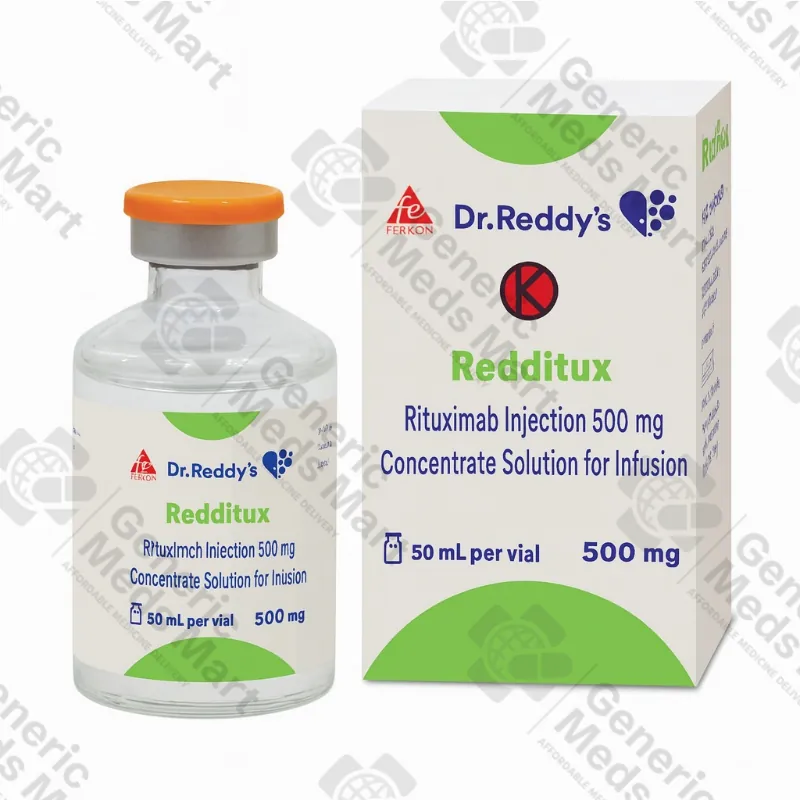
Reditux 500 mg Rituximab Injection (1 vial / 50 mL)
Original price was: $1,150.00.$899.00Current price is: $899.00.
50 vials in pack → $ 17.98 / vial
Reditux 500 mg rituximab injection (1 vial / 50 mL) is a CD20-targeted monoclonal antibody concentrate for IV infusion used under specialist supervision in CD20-positive non-Hodgkin lymphoma, chronic lymphocytic leukemia, rheumatoid arthritis and ANCA-associated vasculitis. Generic Meds Mart supplies Reditux 500 mg in original refrigerated vials from licensed distributors with discreet, trackable international shipping where regulations allow.
Buy Reditux 500 mg Rituximab Injection Online
Reditux 500 mg Rituximab Injection (1 vial / 50 mL)
At a Glance
Generic Name: Rituximab
Brand Name: Reditux 500 mg
Strength & Pack Size: 500 mg rituximab in 50 mL, 1 single-use vial
Dosage Form & Route: Sterile concentrate for solution for IV infusion after dilution
Therapeutic Class: CD20-targeted chimeric monoclonal antibody (biologic / biosimilar)
Primary Indications: CD20-positive non-Hodgkin lymphoma, chronic lymphocytic leukemia, rheumatoid arthritis and ANCA-associated vasculitis (where approved)
Typical Use in Therapy: Given in cycles or courses, often alongside chemotherapy or immunosuppressive regimens in specialist infusion centres
Mode of Action: Binds CD20 on B lymphocytes and triggers immune-mediated B-cell depletion
Key Benefits: Proven improvements in response and disease control across multiple CD20-positive malignancies and autoimmune diseases when used according to guidelines
Precautions: Risk of serious infusion reactions, infections, HBV reactivation and rare PML; requires screening, premedication and close monitoring
Storage: Keep refrigerated at 2–8 °C in the original carton, protect from light, do not freeze
Product Description
Reditux 500 mg is a rituximab injection supplied as a 500 mg/50 mL single-use vial of CD20-targeted monoclonal antibody concentrate for solution for infusion. Rituximab has transformed the management of many B-cell malignancies and immune-mediated diseases by selectively depleting CD20-expressing B lymphocytes. As a rituximab biosimilar, Reditux 500 mg rituximab injection is designed to offer comparable quality, safety and efficacy to reference rituximab when used in line with approved indications and specialist protocols.
Reditux 500 mg rituximab injection is used in CD20-positive non-Hodgkin lymphoma, chronic lymphocytic leukemia and selected autoimmune conditions such as rheumatoid arthritis and ANCA-associated vasculitis. In oncology, it is usually combined with standard chemotherapy backbones and given in repeated cycles or maintenance courses. In autoimmune diseases, it is used as an advanced biologic option when conventional disease-modifying therapies or TNF inhibitors have not provided adequate control. In all cases, treatment planning, dosing and monitoring are the responsibility of experienced haematologists, oncologists or rheumatologists.
Generic Meds Mart sources Reditux 500 mg rituximab injection exclusively from licensed manufacturers and authorised distributors that follow Good Manufacturing Practice and maintain full batch traceability. Vials are supplied in original refrigerated packaging, and orders are shipped in neutral outer boxes so that there is no visible reference to lymphoma, leukemia or autoimmune disease on the parcel. Where available, shipments include tracking to help infusion centres coordinate appointment scheduling. Our role is limited to access and logistics; all clinical decisions about whether and how to use rituximab remain with your specialist team.
Key Uses
Reditux 500 mg rituximab injection is generally used for the following indications, in line with local prescribing information and established guidelines:
Reditux 500 mg is widely used in CD20-positive non-Hodgkin lymphoma, including indolent and aggressive B-cell subtypes, as part of combination chemotherapy regimens and sometimes as maintenance therapy. In chronic lymphocytic leukemia (CLL), rituximab is often combined with chemotherapy or targeted agents in patients whose leukemic cells express CD20.
Outside oncology, rituximab is used in moderate to severe rheumatoid arthritis in adults with active disease who have had an inadequate response or intolerance to one or more TNF inhibitors. It is also used in ANCA-associated vasculitis, including granulomatosis with polyangiitis (GPA) and microscopic polyangiitis (MPA), where B-cell depletion forms an important component of induction and maintenance strategies in many treatment protocols.
The decision to use Reditux 500 mg, the dosing schedule and the number of vials required per course are all defined by the treating specialist based on body size, diagnosis, disease burden, prior therapies, comorbidities and treatment goals.
How Rituximab Works in Chemotherapy
Rituximab, the active ingredient in Reditux 500 mg, is a chimeric monoclonal antibody directed against the CD20 antigen on B lymphocytes. CD20 is expressed on most normal and malignant B cells from early pre-B stages through to mature B cells, but not on stem cells or plasma cells. This pattern allows selective depletion of circulating and tissue B cells while preserving regenerative capacity and long-lived plasma cells.
When Reditux 500 mg rituximab injection is infused, rituximab binds to CD20 on the surface of B cells and “flags” them for destruction through several immune mechanisms. Antibody-dependent cellular cytotoxicity recruits effector cells such as natural killer cells to attack rituximab-coated B cells. Complement-dependent cytotoxicity activates the complement cascade, which leads to membrane attack complex formation and cell lysis. Rituximab can also trigger direct apoptotic signalling within CD20-positive cells.
By reducing malignant or autoreactive B-cell populations, rituximab helps shrink CD20-positive lymphomas and leukemias and can reset dysregulated humoral immunity in autoimmune diseases. Over time, B cells typically repopulate after treatment, and the timing of this recovery depends on dose, regimen, concomitant therapies and individual factors.
Dosage & Administration
Reditux 500 mg rituximab injection must only be prescribed and administered by physicians experienced in oncology, haematology or rheumatology, in settings that can manage serious infusion reactions. The 500 mg/50 mL vial is never given undiluted. Instead, the concentrate is diluted into a compatible infusion solution and administered intravenously over several hours.
Patients are typically premedicated with corticosteroids, antihistamines and antipyretics to reduce the risk of infusion-related reactions such as fever, chills, rigors or bronchospasm. The first infusion is usually started slowly and escalated stepwise under continuous monitoring; if tolerated, subsequent infusions may be given at higher rates. Dosing regimens may be expressed in mg/m² or as fixed milligram doses depending on the indication, and treatment may involve induction and maintenance phases or repeated cycles tied to chemotherapy.
The exact number of Reditux 500 mg vials per infusion, the interval between infusions and the total treatment duration must follow the official product information and your specialist’s protocol. Patients should never attempt to adjust rituximab dose, frequency or infusion speed on their own.
Precautions
Before starting Reditux 500 mg, your clinician will review your medical history, physical examination, organ function, vaccination records and infection risk. Screening for hepatitis B virus (HBV) is usually performed because rituximab can cause HBV reactivation in previously exposed patients, which may be life-threatening. The team will also consider tuberculosis, other chronic infections and recent or planned vaccinations.
Because rituximab is associated with serious infusion reactions and immunosuppression, Reditux 500 mg should be administered only in facilities that can respond rapidly to acute reactions and monitor patients closely. Live vaccines are typically avoided during and shortly after rituximab therapy, and inactivated vaccines may be less effective. Contraception is strongly recommended during therapy and for a period afterwards, since rituximab can affect fetal B-cell development and neonatal immune status if given during pregnancy.
Rituximab Side Effects
Common side effects
Common rituximab side effects observed with Reditux 500 mg include infusion-related symptoms such as fever, chills, rigors, headache, flushing, mild shortness of breath, itching or rash during or shortly after the infusion. Many patients also report fatigue, nausea, mild abdominal discomfort, temporary blood pressure changes and transient reductions in white blood cell or platelet counts. These effects are often manageable by adjusting the infusion rate, providing supportive medicines and optimising premedication for subsequent infusions.
Serious side effects
Serious rituximab adverse effects require urgent medical attention. These include severe infusion reactions with bronchospasm, marked breathing difficulty, chest pain, angio-oedema, hypotension or anaphylaxis; severe infections and sepsis; hepatitis B virus reactivation with potentially fatal liver failure; progressive multifocal leukoencephalopathy (PML) presenting with new or worsening neurological symptoms; severe mucocutaneous reactions such as Stevens–Johnson syndrome and toxic epidermal necrolysis; tumour lysis syndrome in high tumour burden states; and serious cardiac events in susceptible patients.
Patients should be advised to seek immediate medical care if they experience high fever, severe weakness, confusion, visual changes, difficulty speaking, severe rash, peeling skin, marked jaundice, chest pain or acute breathing difficulties during or after Reditux 500 mg rituximab injection treatment.
Storage
Reditux 500 mg vials must be stored in a refrigerator at 2–8 °C in their original carton to protect from light and physical damage. The solution must not be frozen or shaken. Storage, preparation and disposal are usually handled by hospital pharmacies or infusion centres that maintain cold-chain records and follow local guidelines for biologic and cytotoxic waste. Once diluted, the prepared rituximab infusion solution has specific in-use stability limits, and it must be prepared and administered according to the product information and institutional policies.
Why Buy from Generic Meds Mart
Generic Meds Mart is focused on structured access to essential oncology and immunology biologics such as Reditux 500 mg rituximab injection. We work only with licensed manufacturers and authorised distributors that comply with Good Manufacturing Practice standards and maintain verifiable batch documentation. Each 500 mg/50 mL vial is supplied in sealed original packaging so infusion centres can confirm brand, strength, batch number and expiry before preparation.
Prices are shown in USD to make budgeting for repeated cycles or maintenance courses more transparent. Orders are shipped in discreet outer boxes without references to lymphoma, leukemia or autoimmune disease, and where available, tracking is provided so that treatment teams can synchronise appointments with expected delivery dates. Our customer support can help with ordering and logistics queries, but we do not provide medical advice; all clinical decisions about rituximab use remain with your specialist team.
Order Now
Reditux 500 mg rituximab injection is a potent, hospital-only biologic that must not be started without a clear treatment plan. Before ordering from Generic Meds Mart, you should discuss rituximab with your haematologist, oncologist or rheumatologist and receive written guidance on indication, CD20 status, dosing schedule, infusion setting, premedication and monitoring requirements.
Once your plan is agreed, your team can calculate how many vials of Reditux 500 mg (1 vial / 50 mL) are needed for the initial cycles or maintenance period. You can then select the required quantity on Generic Meds Mart, add it to your cart and complete secure checkout in USD. Your medicines will be dispatched in discreet packaging with full product documentation. You should never start, stop, delay or change rituximab therapy without consulting your specialist, and any new, severe or concerning symptoms should prompt immediate medical review.
FAQ about Reditux (Rituximab)
Q1: What conditions is Reditux 500 mg used to treat?
Reditux 500 mg contains rituximab, a CD20-targeted monoclonal antibody used in CD20-positive non-Hodgkin lymphoma, chronic lymphocytic leukemia, rheumatoid arthritis and ANCA-associated vasculitis such as granulomatosis with polyangiitis (GPA) and microscopic polyangiitis (MPA), according to local approvals and guidelines.
Q2: Is Reditux 500 mg given as a drip or an injection?
Reditux 500 mg rituximab injection is a concentrate for solution for infusion. The 500 mg/50 mL vial is diluted into a larger volume of compatible solution and given as an intravenous drip over several hours in a hospital or infusion centre; it is not injected as a rapid IV push or routine subcutaneous shot.
Q3: How long does a typical Reditux infusion take?
The first Reditux 500 mg rituximab infusion is usually administered very slowly and can take several hours, as the infusion rate is gradually increased while staff monitor for reactions. If tolerated, later infusions may be faster, but exact timing depends on the indication, prescribed dose and your individual tolerance, and is determined by your infusion team.
Q4: Can I receive vaccines while on rituximab treatment?
Because rituximab depletes B cells, vaccine responses may be reduced, and live vaccines may be unsafe during and shortly after therapy. Where possible, important vaccinations are given before starting rituximab therapy. You should always discuss the timing and type of any vaccine with your specialist before receiving it.
Q5: Will my B cells recover after finishing Reditux 500 mg?
After completing rituximab treatment, B-cell counts generally recover gradually over months, but the time course varies between individuals and depends on cumulative dose, concomitant therapies and underlying disease. Your specialist may monitor B-cell counts and immunoglobulin levels and will advise you on infection precautions and vaccine planning during and after recovery.
Be the first to review “Reditux 500 mg Rituximab Injection (1 vial / 50 mL)”
You must be logged in to post a review.
Related products
Sale!
Original price was: $56.00.$52.00Current price is: $52.00.
Sale!

Original price was: $146.00.$115.00Current price is: $115.00.
Sale!

Original price was: $39.00.$36.00Current price is: $36.00.
Sale!
Anticancer
Original price was: $52.00.$49.00Current price is: $49.00.
Reviews
There are no reviews yet.