

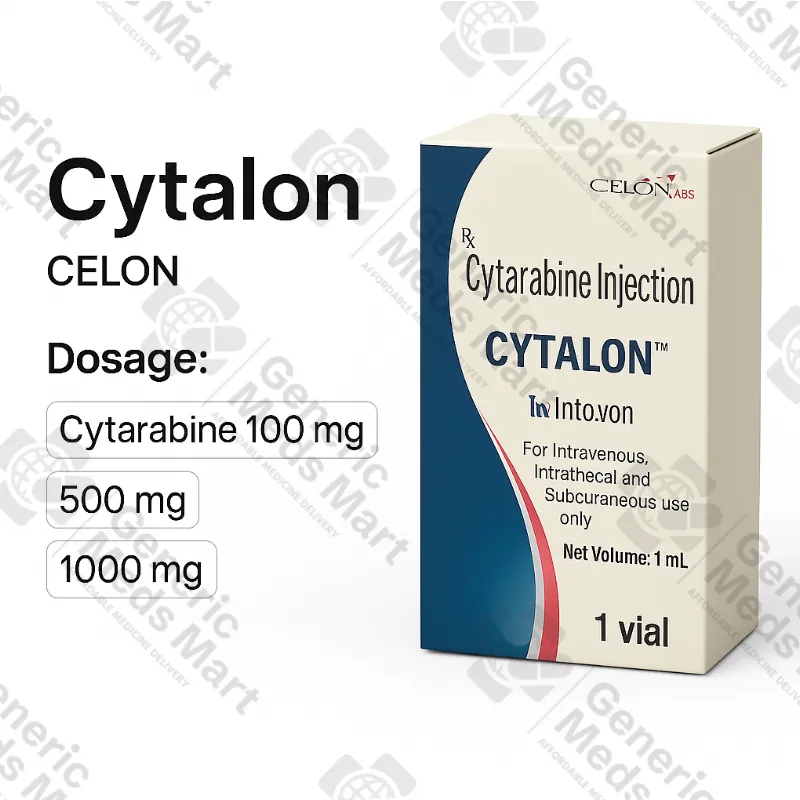
Cytalon 100 mg, 500 mg, 1000 mg (Cytarabine) Injection
Price range: $6.00 through $27.00
Cytalon is a cytarabine-based injectable chemotherapy supplied as 100 mg, 500 mg and 1000 mg single-use vials of lyophilised powder for solution for injection or infusion in acute leukaemias and related blood cancers. Cytalon cytarabine vials are prepared and administered only in hospitals or specialist centres, and Generic Meds Mart supplies all three strengths in original oncology cartons from licensed distributors with discreet, trackable international shipping where regulations allow.
Buy Cytalon 100 mg, 500 mg and 1000 mg Cytarabine Injection Vials Online
Cytalon 100 mg, 500 mg and 1000 mg Cytarabine Injection Vials
At a Glance
Generic Name: Cytarabine
Brand Name: Cytalon
Strength & Pack Size: 100 mg, 500 mg and 1000 mg single-use cytarabine vials
Dosage Form & Route: Lyophilised powder for IV, subcutaneous or intrathecal injection after reconstitution
Therapeutic Class: Antimetabolite chemotherapy (pyrimidine analogue)
Primary Indications: Acute leukaemias and related blood cancers, as per specialist protocols
Usual Use in Therapy: Induction, consolidation or intensification cycles in combination regimens
Prescription Status: Prescription-only cytotoxic medicine for hospital or specialist centre use
Storage: Store in the original carton below 25 °C, protected from light, and handle as cytotoxic
Product Description
Cytalon is a cytarabine-based injectable chemotherapy used in the treatment of acute leukaemias and related blood cancers under the supervision of experienced haematology teams. Each Cytalon vial contains cytarabine as a lyophilised powder that must be reconstituted with an appropriate diluent before use. Depending on the regimen, the reconstituted solution may be given intravenously, subcutaneously or, in specific protocols, by other specialist routes such as intrathecal administration. The availability of Cytalon 100 mg, 500 mg and 1000 mg vials allows clinicians to match the total cytarabine dose to body-surface-area–based calculations and specific cycle designs with precision.
Cytarabine has long been a cornerstone of acute myeloid leukaemia treatment and also features in regimens for other forms of leukaemia and certain haematologic conditions. Cytalon cytarabine vials can be incorporated into induction schedules aimed at rapidly reducing leukaemic blast counts and into consolidation or intensification phases designed to deepen and prolong remission. The exact role of Cytalon in an individual treatment plan depends on disease subtype, prior therapy, co-morbidities and local or international protocols followed by the treating centre. Cytalon cytarabine is not used as a self-administered medicine at home; all preparation and administration are carried out by trained healthcare professionals.
Generic Meds Mart supplies Cytalon 100 mg, 500 mg and 1000 mg cytarabine vials in original manufacturer cartons obtained from licensed oncology distributors. Each pack displays the brand name, strength, generic name, batch number, expiry date and storage conditions so hospital pharmacy teams can verify every vial before it is added to chemotherapy preparation workflows. Parcels are shipped in neutral outer packaging that does not mention leukaemia, cytarabine or chemotherapy, supporting patient privacy while still providing the traceability needed for safe cytotoxic handling. Our role is to support medicine access and logistics; all therapeutic decisions remain with your haematologists and oncologists.
Key Uses
Cytalon cytarabine vials are used in the management of various acute leukaemias and related blood cancers, most notably acute myeloid leukaemia. Cytarabine may also be part of regimens for acute lymphoblastic leukaemia, chronic myeloid leukaemia in blast crisis and certain meningeal or central nervous system involvements where intrathecal schedules are prescribed. Cytarabine is almost always used in combination with other chemotherapy agents and supportive measures rather than as a single agent.
The specific indication and schedule for Cytalon cytarabine depend on the precise leukaemia subtype, cytogenetic risk profile, age, organ function, infection status and previous treatments a patient has received. Some regimens use standard-dose cytarabine, while others employ high-dose cytarabine blocks as part of consolidation. Your haematology team will determine whether Cytalon cytarabine is suitable in your situation and, if so, at which stage of the treatment pathway it should be used and with which combination partners.
How Cytarabine Works in Chemotherapy
Cytarabine, the active ingredient in Cytalon, is an antimetabolite and pyrimidine analogue that interferes with DNA synthesis in rapidly dividing cells. Once administered, cytarabine is taken up into cells and converted into an active triphosphate form that competes with natural nucleotides during DNA replication. By being incorporated into growing DNA strands, cytarabine disrupts chain elongation and inhibits key enzymes, particularly DNA polymerase, that are essential for accurate DNA synthesis.
Leukaemic blasts and other rapidly dividing malignant cells rely heavily on continuous DNA replication, which makes them particularly vulnerable to cytarabine’s mechanism of action. As DNA synthesis becomes impaired, these abnormal cells accumulate damage and undergo cell death. Normal cells that divide quickly, such as bone marrow progenitors and gastrointestinal lining cells, can also be affected, which explains many of the side effects associated with cytarabine. The balance between anti-leukaemic efficacy and toxicity is carefully managed by experienced clinicians through dosing schedules, supportive care and close monitoring.
Dosage & Administration
Cytalon cytarabine dosage is determined entirely by the treating haematology team and often expressed in milligrams per square metre of body surface area. Regimens may involve continuous infusions over several days, intermittent infusions, subcutaneous injections or specialised intrathecal doses, depending on the protocol and disease setting. Cytalon 100 mg, 500 mg and 1000 mg vials provide flexibility for pharmacists and chemotherapy nurses to reconstitute the exact total cytarabine dose needed for each cycle or treatment block.
Cytalon vials must be reconstituted with the recommended diluent by trained staff using aseptic technique in a controlled preparation area, often a pharmacy clean room or chemotherapy mixing space. The reconstituted solution is then administered via a central or peripheral line, subcutaneous injection or other defined route, with patients monitored during and after treatment for side effects and infusion-related issues. Schedules typically include rest periods between cycles to allow bone marrow recovery and management of toxicities. Patients should never attempt to handle or inject Cytalon cytarabine themselves.
Precautions
Before starting Cytalon cytarabine, your medical team will review your blood counts, liver and kidney function, cardiac status, neurological history and any current infections. Cytarabine can cause profound bone marrow suppression, so a baseline full blood count and frequent monitoring during treatment are essential. Existing infections need to be treated and controlled, as cytarabine further suppresses the immune system and can increase the risk of serious or opportunistic infections.
Cytarabine may also affect liver and kidney function, so dose adjustments or special precautions might be necessary for patients with impaired organ function. In high-dose or intrathecal regimens, cytarabine has been associated with neurological side effects, so any previous neurological conditions will be taken into account when designing a treatment plan. Because cytarabine can be harmful to a developing baby, effective contraception is usually required during therapy and for a period afterwards, and cytarabine is generally avoided in pregnancy and breastfeeding unless there is a compelling reason and this is clearly documented by the treating team.
Cytarabine Side Effects
Common side effects
Common cytarabine side effects include bone marrow suppression leading to low white blood cell counts, low red cells and low platelets, which can manifest as increased susceptibility to infections, fatigue, pallor, easy bruising or bleeding. Gastrointestinal symptoms such as nausea, vomiting, diarrhoea, abdominal discomfort and mouth sores are also frequent, particularly at higher doses. Many patients experience hair thinning or hair loss, loss of appetite, mild fever, general weakness and injection-site irritation or phlebitis at the infusion site. These effects are often managed with anti-nausea medicines, mouth care protocols, growth factors, transfusions and supportive measures guided by the haematology team.
Serious side effects
Serious cytarabine adverse effects require urgent medical attention and may lead to dose adjustment or discontinuation. These include severe infections or sepsis in the setting of neutropenia, significant bleeding due to marked thrombocytopenia, severe mucositis, pronounced liver or kidney dysfunction, and rare but important neurological events such as cerebellar toxicity with unsteady gait, slurred speech or coordination difficulties. High-dose cytarabine or intrathecal cytarabine regimens need especially careful neurological monitoring. Any high fever, chills, confusion, unusual bruising, black or bloody stools, sudden difficulty walking, severe headache or new visual changes during Cytalon therapy should be reported immediately to the treating team or emergency services.
Storage
Unopened Cytalon 100 mg, 500 mg and 1000 mg vials should be stored below 25 degrees Celsius in their original cartons, protected from light and moisture, and handled in accordance with local cytotoxic medicine guidelines. Reconstituted cytarabine solutions have limited stability and must be used or discarded according to the product information and institutional policies, usually under the supervision of the hospital pharmacy or chemotherapy unit. Patients themselves are not expected to store, transport or dispose of reconstituted Cytalon vials; this is managed entirely by clinical staff using approved cytotoxic waste procedures.
Why Buy from Generic Meds Mart
Generic Meds Mart helps hospitals, clinics and patients access Cytalon cytarabine vials in regions where supply, cost or local distribution may otherwise limit choice. We work only with licensed oncology manufacturers and authorised distributors who follow Good Manufacturing Practice standards and maintain rigorous batch and expiry tracking. By supplying Cytalon 100 mg, 500 mg and 1000 mg vials in sealed, original cartons, we support hospital pharmacies in verifying product identity and strength before incorporation into chemotherapy protocols.
All Cytalon orders through Generic Meds Mart are processed in USD via secure online checkout, and shipments are packed in neutral outer cartons that do not mention leukaemia, cytarabine or chemotherapy. Where available, trackable delivery options allow haematology services to plan upcoming induction or consolidation cycles around confirmed delivery dates, helping to reduce the risk of treatment delays caused by supply issues. Our role is to support timely, discreet and verifiable access to the cytarabine strengths prescribed by your specialists; all decisions about when and how to use Cytalon remain strictly with your medical team.
Order Now
Before ordering Cytalon from Generic Meds Mart, you should already have a confirmed diagnosis of acute leukaemia or a related blood cancer and a clear written treatment plan from your haematologist that specifies cytarabine, the intended dose, the number of cycles and the route of administration. Your treating centre will determine whether Cytalon is a suitable cytarabine brand for your regimen and will calculate how many 100 mg, 500 mg and 1000 mg vials are required for each cycle and for the full planned course.
You should not attempt to choose cytarabine doses, alter vial strengths or modify your schedule on your own. If you experience new or worsening symptoms such as high fever, uncontrolled bleeding, sudden confusion, difficulty walking, severe abdominal pain, chest pain or shortness of breath during cytarabine-based treatment, seek urgent medical attention rather than adjusting or stopping therapy yourself. Generic Meds Mart exists to help ensure that the Cytalon cytarabine your specialists have selected is available in the right strengths at the right time, while the complex medical management of your cancer remains in the hands of your haematology team.
FAQ about Cytalon (Cytarabine)
Q1: What types of cancer is Cytalon used to treat?
Cytalon contains cytarabine, an antimetabolite chemotherapy used mainly in the treatment of acute leukaemias and some related blood cancers. Depending on the protocol, cytarabine can be part of induction, consolidation or intensification regimens for acute myeloid leukaemia and other leukaemia subtypes, always under specialist supervision.
Q2: How is Cytalon different from oral chemotherapy?
Cytalon cytarabine is supplied as vials of lyophilised powder that must be reconstituted and given by injection or infusion, not taken by mouth. This allows precise control over dose and route, including intravenous, subcutaneous and, in selected cases, intrathecal administration. Because it is a potent cytotoxic medicine, Cytalon is prepared and administered only in hospitals or specialist centres, unlike some oral chemotherapy tablets that patients may take at home according to instructions.
Q3: Will I need to stay in hospital while receiving Cytalon?
Whether treatment with Cytalon cytarabine requires inpatient admission or can be given in a day-case setting depends on the specific regimen, your overall health, blood counts and the intensity of monitoring required. Some cytarabine schedules are delivered during hospital stays, while others may be administered in day-care units with regular visits. Your haematology team will explain the planned setting for each phase of your cytarabine-based therapy.
Q4: Can Cytalon be used again if my leukaemia relapses?
In some situations cytarabine can be used in more than one phase of therapy, for example in both initial induction and later relapse regimens, but this depends on your previous exposure, cumulative dose, response and side-effect profile. Your haematologist will consider prior treatments, remission duration and current disease features before deciding whether another cytarabine-containing regimen, including Cytalon, is appropriate in the relapse setting.
Q5: What can I do to reduce infection risks while on Cytalon?
Because cytarabine lowers white blood cell counts, infection prevention is very important during Cytalon treatment. Your team may recommend measures such as careful hand hygiene, avoiding crowds and people with obvious infections, following any neutropenic diet advice given locally, and promptly reporting fevers or signs of infection. In some regimens, prophylactic antibiotics, antivirals or antifungals may be used. Your haematology unit will provide specific written guidance tailored to your situation.
| Strength & Pack | 100 mg vial, 500 mg vial, 1000 mg vial |
|---|
Be the first to review “Cytalon 100 mg, 500 mg, 1000 mg (Cytarabine) Injection”
Related products
Sale!
Original price was: $56.00.$52.00Current price is: $52.00.
Sale!
Anticancer
Original price was: $52.00.$49.00Current price is: $49.00.

Reviews
There are no reviews yet.